






Friday | Piraeus
A journey to Mykonos always begins before you arrive.
It begins in the boarding line, where someone has already taken off their sandals and is holding them in one hand, as if they were already on the beach. It begins when the port starts to shrink behind you and you realise that the city — the noise, the obligations, the speed of it all — cannot follow you here.
On deck, the salt clings to your skin faster than you remember. The sun warms the metal beneath your feet. The Aegean unfolds in all its shades: first dark, then green, then that blue with no real name. Your gaze learns, once again, how to rest on the horizon.
A girl leans against the rail beside you. She turns, almost for no reason at all.
“First time?”
“Not to Mykonos. But it is the first time I’m going to see it differently.”
She smiles as though she has heard that before — and as though she believes that this time it might actually be true.
“Then don’t begin with the obvious.”
Saturday | The Mykonos with no hashtag
The first thing that touches you when you step onto the island is not an image. It is air. The meltemi here does not simply blow — it moves across you, carrying away the dust of the journey, opening something inside you that had been closed. It smells of salt, thyme, and sun-warmed stone.
Morning finds you moving without a map. The road north narrows quickly — asphalt giving way to dirt, dirt turning into a path. At Fokos, 13 kilometres from Chora, the beach waits without ceremony: deep, clear water, stones rounded by centuries of waves, a taverna that smells of fish and olive oil and has no menu — only whatever the day has brought in. You sit. You listen to the sea. Your body remembers how to do nothing.
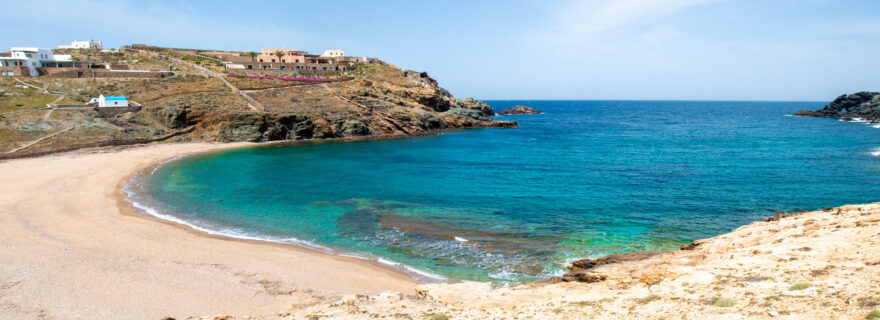
From there, on foot, you reach Mersini. A cradle of rocks wrapped around a small cove. There is nothing here — no umbrellas, no bar, no one watching you. Only you, the sun, and the feeling that you have arrived somewhere no one was expecting you. This is the Mykonos most people do not know: raw, uncontrived, utterly indifferent to its own image.
If you still have time, and a little nerve, the dirt road continues eastward. Vatheia Lagada, at the very edge of the island’s edge, does not appear on any tourist map. You either arrive with four wheels, or you do not arrive at all. And when you finally see it — a small strip of sand between rocks, with water so clear it seems unreal — you understand why some places are worth the effort.
Moments and flavours of the place
Ano Mera does not welcome you with noise. You arrive there almost by accident — or so you think. A square, a few tables in the sun, the scent drifting out from inside, and the Monastery of Panagia Tourliani standing at the centre with the stillness only things that know they will endure can possess. You sit down. There is no reason to leave in a hurry.
On the table come kopanisti — dense, spicy, uncompromising in character — and louza, the local cured meat that smells of wind, winter, and dry hillsides. Barley rusks, tomato, a little olive oil melting immediately into the bread.
The owner sets it down without ceremony.
“This is Mykonos.”
“The other Mykonos?” your friend asks.
“The real one,” he says, before disappearing back into the kitchen.
Saturday afternoon | Where the wine grows
A little farther out, the road narrows and the landscape changes. Less white, more earth. Vines, olive trees, animals moving freely through a yard that has no idea what Instagram means.
Vioma Organic Farm is the island’s only commercial vineyard — something that says a great deal in itself about Mykonos and its relationship with wine. The Asimomytis family lead you through the vines with the voice of someone who does not explain, but shares. Assyrtiko, Athiri, Mandilaria: Aegean varieties growing slowly in dry soil under a wind that never stops. What would be an obstacle elsewhere becomes character here.
A little farther down, at Mykonian Land, the Sikiniotis family keeps another kind of memory alive. The stone wine press was built by grandfather Lefteris in 1960 — now his grandson Gerasimos pours wine into your glass, and a little later picks up the lute. It is not a performance. It is simply how he grew up.
You drink it with cheese, louza, and wood-fired bread, and for a moment you do not feel like a tourist. You feel like a guest.
Sunday | The edge of the island
The morning begins with walking. A path, stone, thyme, the wind whistling through the dry-stone walls.
At Armenistis Lighthouse, the wind blows without asking permission. Since 1891, the lighthouse has faced Tinos across the water, as if carrying on a quiet conversation over the sea. Here, Mykonos stops being scenery. It becomes an edge, a passage, a place that gives direction.
Back in Chora in the afternoon, beyond the alleyways, there are places that change the way you see the island. The Archaeological Museum, with finds from Delos. The Aegean Maritime Museum, which tells the story of the Greeks and the sea as something personal rather than merely historical. And Lena’s House — a 19th-century home filled with furniture, textiles, the scent of old wood, and time that seems to have paused with grace.
Here, Mykonos becomes home, memory, and everyday life.
Evening, at the table
Kopanisti, louza, Mykonian sausages, honey scented with thyme. A little more of the wine you drank yesterday with the people who made it themselves.
“This has nothing to do with the Mykonos I was expecting,” your friend says.
“Thankfully,” you reply.
And you mean it.
Mykonos has learned well how to hide behind its own image. But if you give it time — if you take the dirt road all the way to the end, if you sit on a beach that has no place on the tourist map, if you drink wine with people who still remember their grandfather pressing it by foot — then it begins to reveal itself.
Not as a secret.
As a place.
And when you leave, what will stay with you will not only be an island you saw.
It will be an island you felt.