






Athena Greka – MD
Specialist pathologist-Dietician,
Specialisationin Gerontology
www.pathologosgreka.gr
 Yagos Tsikinis -MD
Specialist pathologist-biologist
Specialization in hypertension
fb: @YA.partners
More innovative than anything, it is the simplest and most classic antiseptic method:
Hand washing entered our lives only 170 years ago.
Circumstances led to this discovery of science.
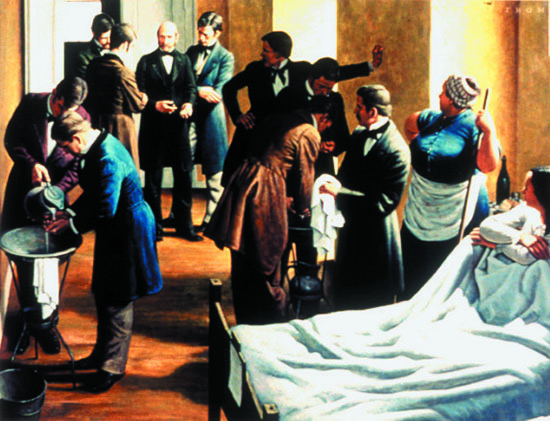 HISTORICAL BACKGROUND
In 1841-1850, Ignaz Semmelweis at the General Hospital in Vienna managed to stop postpartum fever by implementing a hand hygiene programme.
In 1854, Florence Nightgale mandated the use of stiff hand-cleaning brushes in battlefield hospitals after observing that most soldiers died from infections rather than injuries.
But how should we wash our hands?
Certainly not by leaving them under the tap for a few seconds and pouring a little soap on them.
 Proper hand washing should take 40 to 60 seconds and includes the following steps:
1. Turn on the tap and wet your hands with plenty of running water.
2. Add enough soap to cover all the surfaces of the hands.
3. Rub your palms together,
4. Rub the palm of the right hand on the back of the left hand by placing the fingers of the right hand on the interdigital spaces of the left hand and vice versa.
5. Rub the palms and midfingers at intervals, crossing the fingers.
6. Rub the dorsal surfaces of the fingertips of both hands simultaneously, closing each hand in the palm of the other hand.
7. Close the thumb of the left hand into the palm of the right hand and rub it with rotary movements and vice versa.
8. Rub the fingertips of each hand with rotating movements into the palm of the other hand.
9. Rinse well and dry with a disposable towel.
10. We use the same hand towel to turn off the tap.
11. Then use antiseptic solution
The human skin “hosts” a large number of microbes that make up the microbial flora of the skin.
The type of these microbes varies depending on the area of the body.
Hand hygiene protects us from colonisation and infection by pathogens in the environment.
Our hands are a means of transferring pathogens from the environment and vice versa.