






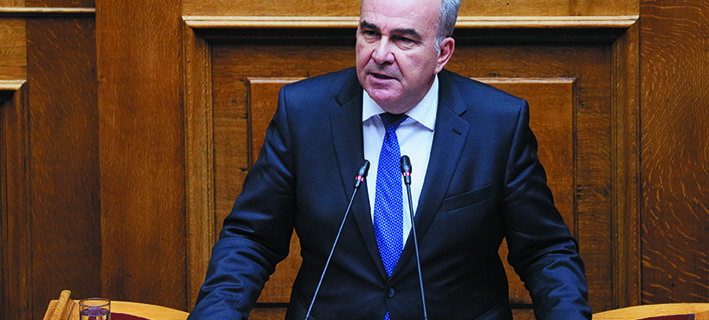
INTERVIEW WITH DEPUTY MINISTER OF DEVELOPMENT AND INVESTMENT, MR. NIKOS PAPATHANASIS TO ANTHONY KIRIKOS
Accelerating investment at all levels is the key priority for the development of Greece in the new era. The Deputy Minister of Development and Investment, Mr. Nikos Papathanasis, analyses the government’s plans and clarifies that geopolitical developments will not affect the benefit programs for businesses and employees.

What are the challenges of such a difficult year for such an important ministry for the economy and development?
2020 is a very different year from 2019 globally. So we are in the midst of a crisis that does not have the characteristics of the Greek crisis of 2010. But it is a crisis without borders that the global community is called upon to address. And in such a way that it can quickly revive the economies of the countries affected. Greece, compared to the other EU member states, is currently in the midst of the pandemic at a lower level than the recession of the first half of the year with 7.9%. This result, especially if one looks at it in comparison with the Southern countries, such as Italy and Spain and France, is the result of the excellent management of the crisis by the government. With only manufacturing remaining strong in the midst of the crisis, and while Greece lags behind in terms of manufacturing’s contribution to GDP at over 40%, below the European average, we found ourselves with a lower recession than the average of the Member States. We should also note that our heavy industry, which is tourism, is particularly affected and yet we have done better than many countries with stronger economies. It is easy to conclude that this is the result of the right decisions taken by the Prime Minister and then the strategy and the coherent programme to restart the economy. A key priority was given to supporting vulnerable groups, wage earners, affected professionals and small and medium-sized enterprises.
The challenges for this year are right in front of us.
As we speculate and hope that we are on a trajectory that will lead us out of the pandemic crisis, we will be faced with the universal demand to accelerate the economy. So the important area where we are called upon to put all our efforts is the management of the Recovery Fund and how the plan will properly distribute its resources to the economy to create the momentum for a fast and effective acceleration.
What is your main priority as Deputy Minister for Development and Investment?
A key priority is to accelerate investment at all levels. We start with private investment, which is supported by the State with appropriate programmes. In this area, we have an obligation to reduce bureaucracy and speed up the registration in the relevant programmes, so that investors are not delayed in starting up their business projects. Then we have an obligation to accelerate public-private partnerships (PPPs) which are important and contribute to the country’s GDP. Foreign direct investment, which is governed by strategic investment procedures, requires particular attention because, despite being subject to the Fast Track regime, it is often delayed, causing the global investment community to distrust it. Therefore, it is our obligation to accelerate this process as well so that strategic investments can be launched without delays.

Do geopolitical developments affect the business and employee benefit plan?
From the very first moment, the government’s intention was to support workers and businesses, precisely to protect jobs. This was more than clear in the speech of the Prime Minister, Mr. Kyriakos Mitsotakis from the podium of the Forum at Helexpo, where he announced a series of measures worth 7 billion. euros to support vulnerable groups, wage earners, small and medium-sized enterprises and the middle class. At the same time, he also announced the main points of the programme to strengthen the defence and deterrence capabilities of the Greek Armed Forces. The government, from the beginning of this crisis, had stated that it will use all the fiscal space available to create support schemes and packages of measures that will support entrepreneurship in the midst of the crisis to shield, to protect jobs. This is what we did with the announcement of the two aid schemes of the Development Law a few days ago. One entitled “General Entrepreneurship” and the other “Micro, Small and Medium Enterprises”, with a total budget of €500 million. €.
Geopolitical developments will therefore not affect the benefit schemes for businesses and employees as they are a separate budget line.
In any case, we here as a country are used to having a very high budget – not only now but also in the past – in order to strengthen our defence capabilities.
What are the main Investment Plans for Greece in the new era?
The main investment projects are based on the circular economy, green growth and especially the restart of our industry. Through the crisis it became clear that industry is one of the key levers supporting the flow of products and was less affected than any other sector. Therefore, the Prime Minister’s objective and our main priority is to increase the investment projects directed to industry so that within four years we will reach 12% from 9% and within a decade 15%. It is a challenge to be able to create many thousands of jobs and support the productive capacity of the country.
The development programmes coming with the Recovery Fund will lead to a restart the economy?
The government has stated from the beginning that the resources of the Recovery Fund will not be distributed without a strategic and coherent programme to support the economy. The money is not going to be scattered without a specific strategy. The government is currently drafting the plan which it will submit to the European Commission on 15 October. The primary objective is sustainable development in value chains that will be an arm for creating new and more jobs for the future. Clearly, therefore, the Recovery Fund, together with all the programmes – the remainder of the NSRF 2014-2020 which is being completed and the new NSRF 2021-2027 programme which is currently being worked on – will act as levers to restart and grow the economy, so that we can achieve the fastest return to previous levels after the pandemic crisis and then immediately accelerate towards the targets we had set before that.

Is Greece an attractive destination for investment?
Greece is an attractive place for investment and this was proven through the pandemic as investors have not stopped being interested in new investments in our country. During the crisis, therefore, many projects became operational and strategic investments that were on the table became operational. At the same time, we have great investment interest in the Elefsina Shipyards and in ELVO and in Skaramagas and in EAV, as the Prime Minister said from Thessaloniki. Therefore, Greece is becoming what he said, a “friendly destination for investors”.
What is your favourite habit that relaxes you after a long day?
My favourite habit is a walk, which relaxes me, a conversation and of course contact with my family, which sometimes, because my children work, there may be two or three days when I haven’t met them. But other habits are also relaxing for me, like reading, whether it’s catching up on information from print and the Internet, or reading a good book.
Your two favorite destinations in Greece and abroad?
I have travelled to many regions of Greece and several countries around the world. Favorite places are those that combine both mountain and sea, such as the mountainous area of Pelion. A second favourite destination is Aitoloakarnania where mountains and lakes coexist, there is a great variety of landscapes. Abroad, I like destinations that have rare characteristics, I like to see different cultures, different even from those in the European environment. Asia and the Middle East are among the favorite destinations.