






of GIANNI-MARIO PAPADOPOULOU

If you ask even the most ignorant about motorsport “what is the Acropolis Rally”, it is impossible not to smile and
not to give an answer: “Greece”.
The Acropolis Rally returned to the World Championship programme. Eight years away from the WRC was a long time. Too many. And this was evident from the reactions of the people. Not just the motorsport fanatics, who would have flooded the mountains anyway to watch the “world-beaters” go by. But also the ignorant, who may not watch car races, but they will go to the “Acropolis”!
” It was the fall of 1951,
from an idea of a group of drivers organized
for the first time
a 1,923 km race. ”

In the beginning…
But let’s look back to the past. It was in the autumn of 1951, from an idea of a group of drivers a 1,923 km race was organized for the first time.
The race started in Athens on 30 November 1951 and the ten cars that participated in it passed in order from Tripoli, Larissa, Thessaloniki, Serres, Kavala, Thessaloniki again, with the finish in Kifissia after almost 43 hours! The winner was Petros Peraticos, with a Fiat 1400.
On January 29, 1952, the vice-president of ELPA and head of the Standing Committee of the Games, Apostolos Nikolaidis, proposed to the Club to undertake the organization of a race under its auspices.
The “Greek Rally” gave way to the “Rally ELPA”, in which 19 cars participated, starting from Ioannina and through the Peloponnese to Thessaloniki, to end up after 2,600 demanding kilometers in Iera Odos, where Johnny Pezmazoglou and Nikos Papamichael finished first, with an 8-cylinder Chevrolet Deluxe.
However, one of the most important dates in the history of the race was November 19, 1952. Apostolos Nicolaides proposed to the ELPA Board of Directors the renaming of the race to “Rally Acropolis” and its transformation from national to international. Which is what happened.
On 29 May 1953, the first “Acropolis Rally” started under the Sacred Rock, with the participation of 26 cars. It was an arduous 1,728-kilometre ordeal. There were many retirements, with Nikos Papamichael taking the victory in a Jaguar XK120 with Spyros Dimitrakos as co-driver.
The water was already in the groove. In 1954 the “Acropolis” became international, when seven crews from foreign countries participated.
”Greece was one of the countries
who were the “founding members”
of the World Rally Championship.”
“Global.”
Greece was one of the countries that were the “founding members” of the World Rally Championship. The “Acropolis” was included in the WRC programme from its very first year. The race has traditionally been known for its difficulty, with crews driving up to 800 racing kilometres on some of the most gruelling special stages.
This trip included locations all over Greece until the late 1980s. Kalambaka, Olympus, Attica, Central Greece, Taygetos, welcomed the world’s top drivers and co-drivers in a battle with the stopwatch. The common thread is the start in the shadow of the Sacred Rock of the Acropolis.
In the 1990s the races began to change. The traditional rallies of more than 50 special stages gradually gave way to “sprint” races of fewer kilometres. But Acropolis has always been there. Usually centered in Lamia.
Thriving and declining…
There is no doubt that until this year the most “significant” moment of the modern “Acropolis” was the 2005 Olympic Stadium’s ultra-special in 2005. Around 70,000 people packed the stands of the stadium, which a year earlier had hosted the Athens Olympics.
The crowd went wild and the WRC “world champions”, ecstatic by the “hot” atmosphere, offered a spectacle that went down in history. And it was enough for the 2005 Acropolis Rally to be described by the World Federation as “the best race of the year”.
In 2008, the centre of “Acropolis” was located at the military airfield of Tatoi, and this was the last time the rally was based in Attica, and special routes around Athens were used.
In 2009 the rally’s headquarters were moved to Loutraki. The last year that our country hosted a “world” Acropolis Rally was in 2013. Since then, the decline began which led to the final exit of the race even from the European Championship programme.
The return
The “Acropolis” has reached its nadir. His reputation, however, still existed. And when in the summer of 2019 the Deputy Minister of Sport, Mr. Lefteris Avgenakis, decided to emphasize the return of “Acropolis” to the international stage, for the first time the coordinated State declared “present” in our national race.

This was followed, in June 2020, by the creation of Motorsport Greece, a special committee under the General Secretariat of Sport, which aims to claim and organise major motorsport events.
The members of the committee, either experienced from past events such as Anita Pasali and Pavlos Athanasoulas, or with less experience but with a great desire to create, did their best and when the return of the Acropolis Rally to the WRC programme was announced on 26 March 2021, they had already done significant preparatory work, so that the months that would follow would have the desired result. Which is what happened…
We’re back!

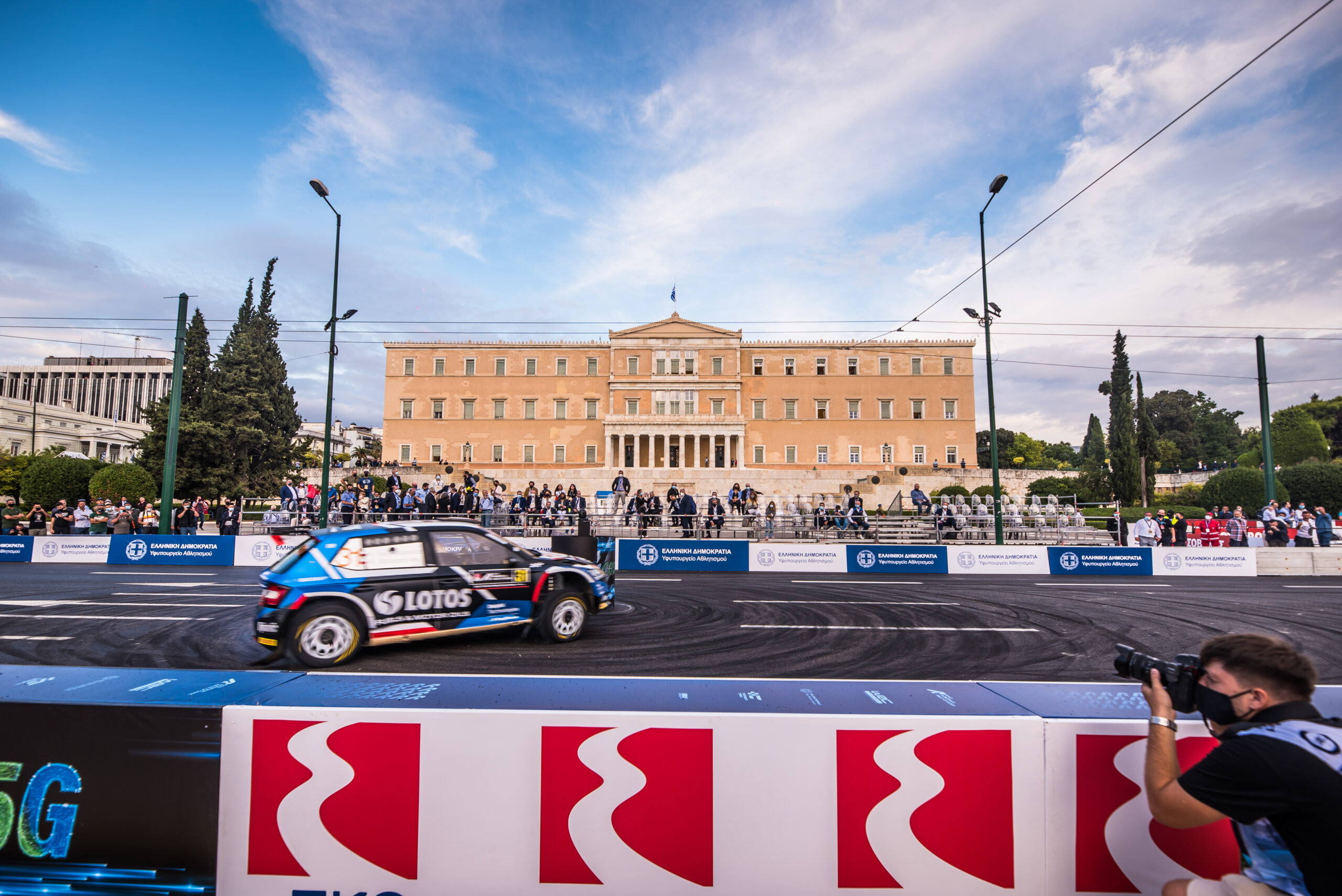
When the first race car, the Hyundai i20N of Lambros Athanasoulas-Nikos Zakhaios, was launched at the Cosmote 5G Athens Stage on Thursday afternoon, September 9th, the dream was coming true.

Greece had returned to the forefront of world motorsport. Athens put on its festive clothes, the streets around Syntagma Square were closed for a different… gathering! Thousands of people watched the top players offer a unique spectacle, doing “donuts” in front of the Unknown Soldier.
The special routes of the Peloponnese and Central Greece received… an invasion of thousands of sports fanatics, who did not even hesitate to stay overnight in nature in order to “get a good position” for the race. And they were compensated by the spectacle.
At the finish of the last special, on the legendary “Tarzan”, an amorphous 20-year-old boy, Finnish Kale Rovanpera, son of the late WRC driver Harry Rovanpera, became the youngest winner of the “Acropolis”.
But the most important thing was that even those drivers who didn’t make it, those who saw luck turn its back on them, had nothing but good things to say about Greece.
And that was the most important thing. Greece is back and will stay on top. And in 2022, and in 2023 and for many years to come, thanks to the valuable assistance of all the stakeholders and the undivided support of the pure fans! Because the success of the struggle is a matter for all of us!