






The Minister of Digital Governance and Artificial Intelligence on how AI and smarter cities can improve life for citizens and travellers
Interview by Lillian Psylla
Greece’s next stage of digital transformation reaches beyond the screen. As public services become more connected and the country develops its artificial intelligence infrastructure, the challenge is to turn technological capacity into changes that people can feel in everyday life. For destinations, that includes easier journeys and better access to information, alongside public spaces that are better managed and communities that are more resilient.
In conversation with GRtraveller, Dimitris Papastergiou, Greece’s Minister of Digital Governance and Artificial Intelligence, sets out his vision for an intelligent state. From the DAEDALUS supercomputer and the PHAROS AI Factory to the everyday experience of a city or an island, he explains how digital sovereignty, reliable data and public trust fit into the same agenda. Its success, he argues, will ultimately be measured by the quality of service people receive.
Connecting the State and Building AI Capacity
Six years after the launch of gov.gr, the discussion seems to be shifting from simply digitising services towards a state that operates as a coherent whole, acts proactively and becomes more intelligent. At what point can we say that we are truly moving from the digital state to the intelligent state?
The transition has already begun. It does not happen overnight and, frankly, it never ends. Nor can anyone know how far a country with determination can go, as Greece is demonstrating under Prime Minister Kyriakos Mitsotakis. Who would have believed a few years ago that we would be inaugurating the DAEDALUS supercomputer and standing at the international forefront of artificial intelligence? Who would have imagined that Greece would be among the first countries selected by the European Union to host an AI factory, PHAROS? In a few years, you will see the ecosystems that develop around DAEDALUS and PHAROS, and how much our country will advance.
We started with gov.gr. Today, it offers more than 2,276 digital services and has brought the state onto citizens’ screens. The next step is to connect its individual parts so that citizens do not need to know which ministry, organisation or department is responsible for each matter they need to resolve.
A truly intelligent state makes secure use of the data it already holds, does not repeatedly ask for the same supporting documents and organises its services around life events: the birth of a child, starting a business, buying a property, retirement. It provides timely information, acts proactively and offers personalised service, always with transparency and respect for personal data.
DAEDALUS and the PHAROS AI Factory are creating AI computing infrastructure on an unprecedented scale in Greece. What changes in practical terms when a country has its own AI infrastructure, and how important is this capability for what we call digital sovereignty?
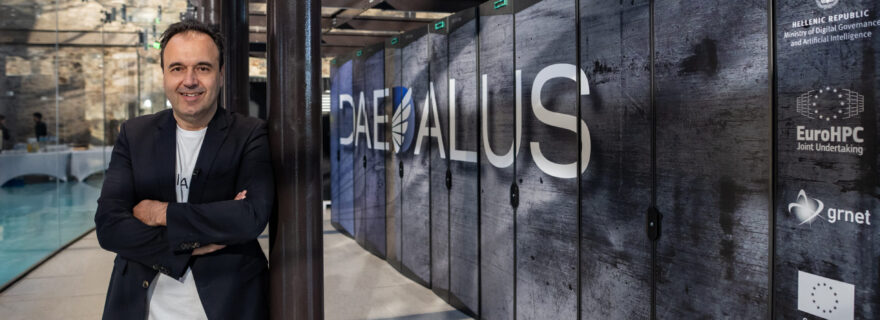
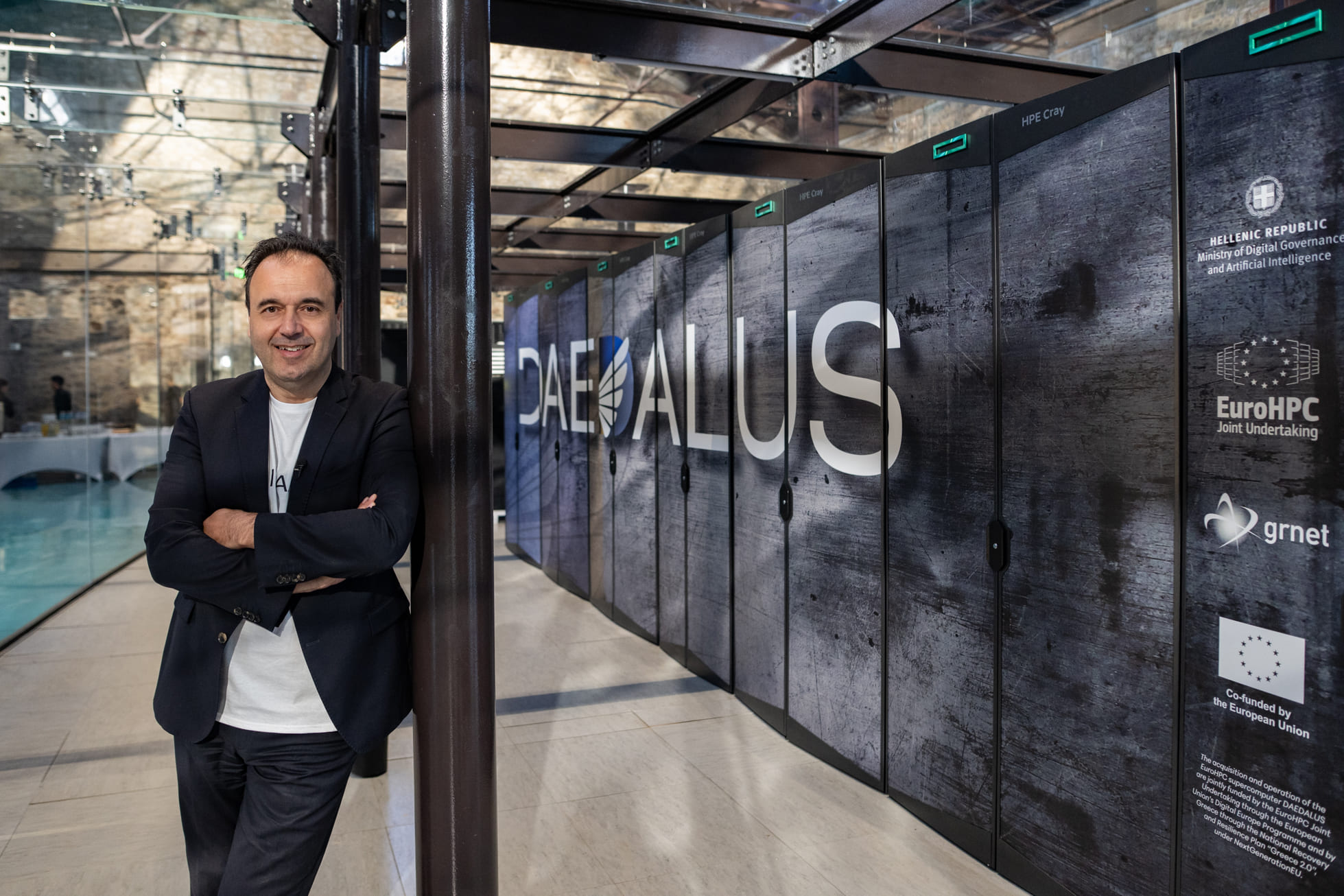
With DAEDALUS and PHAROS, Greece gains the ability to become a producer of knowledge, applications and innovation, rather than simply a consumer of prepackaged technological solutions. With a computing capacity of 89 petaflops, DAEDALUS already ranks 31st in the international TOP500 ranking and 23rd in the Green500. This infrastructure puts the country on the global supercomputing map.
PHAROS complements DAEDALUS. It turns computing power into practical capability for researchers, universities, startups, small and medium enterprises, and the public sector. It gives them access to infrastructure, data, specialist expertise and tools to train and test AI models.
Digital sovereignty does not mean technological isolation. It means that Greece and Europe have their own critical infrastructure, set their own rules and can develop solutions that respond to their language, needs and values.
Cities Designed around Everyday Life
With your background in local government, you have seen at first hand the efforts of cities to become smart. What ultimately makes a city truly intelligent? Is it the sensors and applications, or the extent to which technology makes a measurable difference to people’s everyday lives?
Having served in local government for many years, I believe a smart city is not the one with the most sensors. It is the city that listens, anticipates and solves problems.
Technology is the means. The real aim is to reduce journey times, detect a water leak quickly, improve waste collection, make a road safer and allow a person with a disability to move around without obstacles. A sensor has value only when the information it provides leads to a timely and sound decision.
That requires good data, services that work together, trained staff and measurable goals. We also need to ask citizens whether they are actually seeing a difference. The best smart city is one where technology works discreetly in the background and the improvement is felt in everyday life.
Smart Cities programmes are now being implemented across a large number of municipalities. What are the three things you would most like a resident or visitor to a Greek city to experience differently in everyday life over the coming years?
First, better and more predictable journeys. Information in real time, easier parking, safer routes and greater accessibility for everyone.
Second, public spaces that are cleaner, safer and more resilient. Through smart management of waste, lighting and water, as well as data that help a city respond more quickly to fires, floods or extreme temperatures.
Third, a simple digital relationship with the municipality. Citizens should be able to submit a request from their phone, know who is handling it and track its progress. Visitors should be able to find easily everything they need regarding transport, culture and city services.
Every municipality has different needs. That is why the solutions cannot be the same everywhere. The shared goal, however, must be for technology to give people back time and improve their quality of life.
The Visitor Experience and Destination Resilience
Applications such as mAiGreece, MyCoast and MyStreet show that digital governance now has a direct impact on the visitor experience. Is there a broader vision behind them of what a smart destination means for Greece? How do you imagine a traveller’s digital experience in the country in 2030?
A smart destination is not a destination with more applications. It is a place where technology makes travel easier, safer and more authentic.
mAiGreece offers information in 31 languages and connects visitors to the 112 emergency number when needed. MyCoast allows people to check beach concessions and report violations. MyStreet strengthens transparency in the use of public spaces. Together, these reflect a different philosophy: visitors are not simply consumers of tourism services, but people with a right to information, safety and respect for public space.
In 2030, I imagine a traveller receiving timely information about transport, the weather, accessibility or a potential risk, and discovering less familiar destinations based on their interests. Technology should be almost invisible. It should leave them more time for what remains irreplaceable: Greek hospitality and the real experience of a place.
This summer, Hyperion GR-1 was placed into orbit as part of the National Microsatellite Programme. How does this investment translate into real value on the ground for civil protection, the environment, coastlines, cities and the resilience of Greek destinations?
Hyperion GR-1 is the first Greek optical microsatellite in our new national constellation. Its value, however, does not lie simply in the fact that it is in orbit. It lies in the data that return to Earth and are turned into useful information.
Images captured at high resolution can help map the impact of a fire or flood, monitor coastlines, erosion and forests, identify changes in the urban and natural environment, and better protect critical infrastructure. Combined with the other capabilities of the National Microsatellite Programme, they give us a more comprehensive and frequently updated picture of Greek territory.
Data from space do not replace services on the ground. They give those services a clearer picture, so that they can deploy their resources more quickly and effectively. For a country with thousands of islands, an extensive coastline and intense climate pressures, this is critical infrastructure for resilience.
Data and Trust in Artificial Intelligence
Artificial intelligence requires vast quantities of reliable data. How can the public sector turn the data it already holds from an administrative repository into real infrastructure for innovation, without compromising privacy and security?
Data become valuable when they are of high quality, up to date, properly documented and usable under clear rules. Gathering large volumes of information is not enough. We need to know who needs it, for what purpose and with what access rights.
For data that do not contain personal information, we are expanding open access and reuse through the National Open Data Platform. More sensitive datasets require tiered access, anonymisation or pseudonymisation, secure processing environments and a complete record of every use.
At the same time, interoperability allows information systems to exchange only the data that are strictly necessary, without citizens having to act as couriers of documents between departments.
Privacy and security are not obstacles to innovation. They are its foundation. Without citizens’ trust, no data policy and no AI application can be sustainable.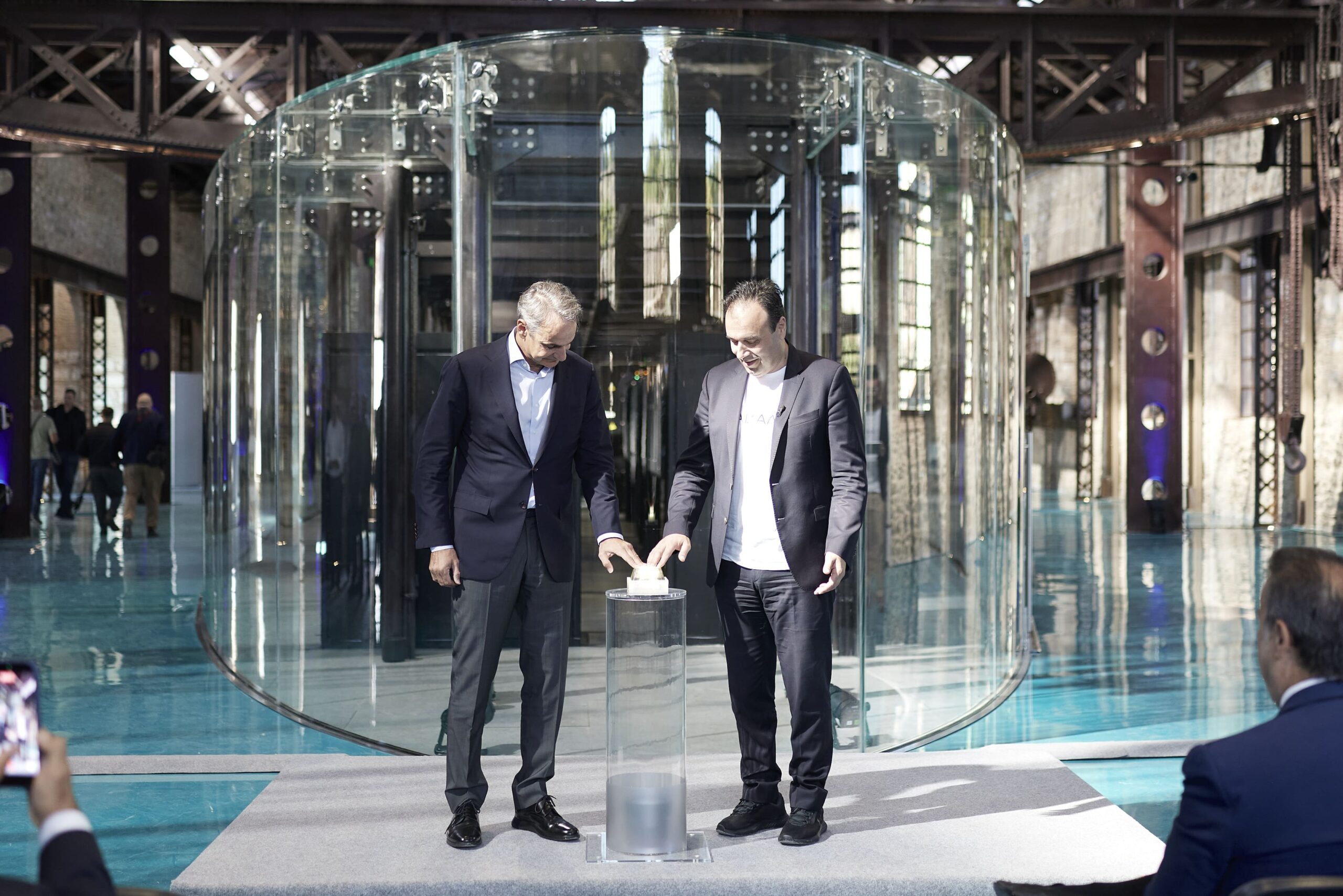
With the implementation of the EU AI Act, Greece is now called upon not only to adopt artificial intelligence but also to regulate it. How do you strike a balance between protecting citizens and avoiding a regulatory environment that holds back innovation?
Good regulation does not treat every AI application in the same way. It focuses on the actual risk. An application that suggests tourist itineraries requires a different set of safeguards from a system that could affect a person’s access to employment, healthcare or a public benefit.
Through Law 5321/2026, we established the national framework for implementing the AI Act, introducing oversight mechanisms, a register of AI systems in the public sector, a complaints mechanism and a regulatory sandbox. The latter is particularly important because it allows businesses and organisations to test innovative solutions in a controlled environment and incorporate safety requirements from the design stage.
Europe can gain a competitive advantage through trustworthy AI. Clear rules provide protection for citizens, as well as certainty for investors and developers.
A Digital Future for Everyone
Technology can create very different rates of progress within the same country, with major urban centres on one side and small municipalities, islands and remote areas on the other. How can we ensure that a smart Greece does not become a country developing at two different speeds?
Digital equality begins with connectivity. That is why we are investing in fibre optics, networks offering very high speeds, 5G and satellite infrastructure. Geography must not determine the quality of the services a citizen receives.
Smaller municipalities must also have support. It makes no sense for every island or mountain municipality to design the same digital infrastructure from scratch. We need shared platforms, technical support, open standards and cloud services that everyone can use.
Digital skills are equally important, as is maintaining alternative ways of accessing services for those who find it difficult. Success is measured not only by how many services we have created, but by whether someone living on a small island can use them as easily as someone in central Athens.
At this year’s Thessaloniki International Fair, you spoke of a Greece that would be digitally sovereign and innovative by 2030. If we were indeed in 2030, what one thing would need to have changed in citizens’ everyday lives for you to say that digital transformation had succeeded?
I would like citizens to have stopped, once and for all, acting as couriers of information between departments of the same state.
They should no longer need to know the organisational chart of public administration, resubmit information the state already holds or keep track for themselves of whether they are entitled to a service or benefit. With their consent and clear safeguards, the state should connect the information, notify them in good time and complete as many procedures as possible without unnecessary steps.
At the same time, a person must always be available when a case is complex or technology is not enough. Digital transformation does not mean an impersonal state.
We will have succeeded when citizens no longer describe a service as digital. They will simply say that the state worked quickly, fairly and properly.
The Measure of Progress
For Greece’s destinations, the significance of this agenda lies in the conditions it could create for both residents and visitors. Better information, responsive local services and stronger environmental monitoring can make a place easier to navigate and better equipped to protect what makes it distinctive. Delivering that promise will depend on cooperation between institutions, reliable data and access that reaches beyond the country’s largest cities. In the minister’s account, progress will be judged by a human outcome: people gaining time to live, work and experience Greece, with confidence that the systems around them will function.