






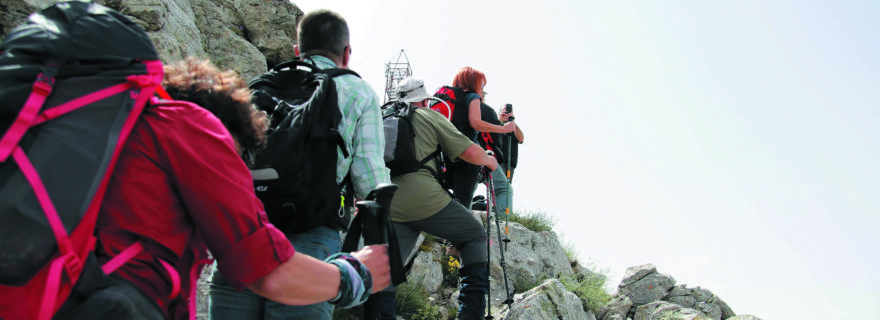
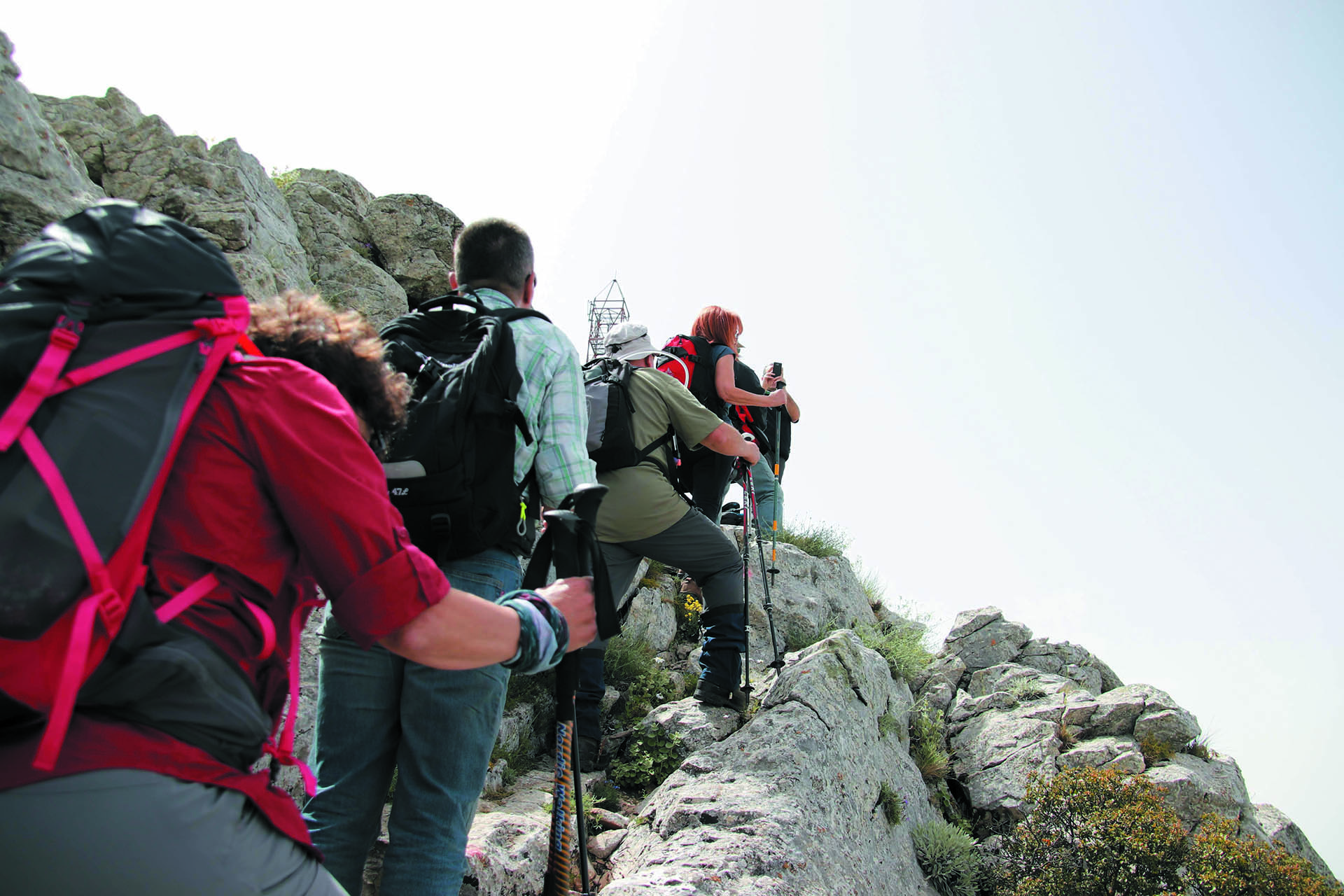
“On every mountain there is a path….”, the American poet Rothke once wrote. So, we choose a good pair of shoes, preferably boots suitable for walking, put a raincoat in our backpack, water and raisins and we are ready to discover as much as we can of the approximately 3,500 km of marked trails of our country. And if you’re wondering, “where to run around Greece now”, we’ve chosen destinations so close to Athens you won’t believe it.
Hymettus
Ymittos has over 30 marked paths for walking, running or cycling. The narrow and long mountain of Attica is a paradise on land, with rich vegetation and many species of mammals such as various species of bats, 112 different species of birds, foxes, hedgehogs and others. At the height of Kaisariani we will meet the Aesthetic Forest, a project of the Athens Philodetic Union. A little further up, the historic monastery of Kaisariani. The scents of orchids, pine trees, eucalyptus and thyme waft past us. The clearing near the church of Agios Markos, overlooking Athens and the Saronic Gulf, is ideal for picnics and fascinating photos. On the eastern side of the mountain we will meet the cave of the Lion while reaching Peania we can visit the largest known and one of the most beautiful caves of Attica, Koutouki, to admire a variety of stalactites and their colors. An evocative monument of nature, just 35 km from Athens. “Hiking in the mountains is an escape from the daily routine of the city. Three hours of hiking on mountain trails is enough to fill our lungs with enough oxygen to last us for the whole week. Moreover, it ’empties’ the mind of the worries of everyday life and calms the mind.”
Manos Kitsellis,
president of the Hymettus Hiking Group


Parnitha
The highest mountain in Attica, Parnitha is located just 30 km northwest of Athens. In the National Park of the capital there are still deer, foxes and rabbits, 120 species of birds and about 800 different kinds of herbs and plants. There are hundreds of paths to walk and dozens of small caves and gorges to explore. Among the most famous are those leading to the mountain shelters of Bafi and Flambouri, but also the traditional path of Mola, which starts from the beautiful chapel of Agios Petros. We fill our canteens with cool gurgling water at the spring opposite the chapel and continue on one of the small or longer hiking trails through the fir trees. The three clearings in the Mola area are suitable for picnics and other nature activities. Approaching from Fili, we will follow the path that will lead us to the cave of Panos, while the more experienced ones, crossing the steep and magnificent gorge of Goura, will find themselves in front of the Holy Monastery of Kleiston, built on the edge of the gorge with a wonderful view of the Attica basin and the islands of the Argosaronikos. Near the central avenue is the now crumbling Sanatorium, which until 1960 treated patients with tuberculosis, including Yannis Ritsos. “The mountain is the company. It’s the human relationships and the contact with the team. There is no point in going alone. Especially for those starting out on hikes, it’s a good idea to integrate into organized groups until, at the very least, they learn the trails and feel safe.”
Eva Balliou,
president of the Mountaineering Association of Acharnon

Pendelic Mount
The Pendelikos Mount, the second largest mountain in Attica, in the shape of a pyramid, is a destination close to Athens for hikers. Some of the most beautiful suburbs of Athens, such as Kifissia, Ekali and Drosia, have been built on its foothills, while as we climb upwards, we enjoy more greenery and from the top of the mountain we enjoy the breathtaking view of the city and the Evian Gulf. An easy trail, even for beginners, is the road that leads to the ancient quarry and continues to the cave of Davelis, the refuge of the dreaded lethargist, who has been associated with legends and frightening theories of conspiracies and supernatural phenomena. On our tour of the mountain we will find many springs, ancient and Byzantine monuments, of which the most famous and one of the largest in Greece, the Penteli Monastery. The mountains of Attica do not have difficult and steep paths. Their difficulty lies in the difference in altitude (if they are uphill) and the length of the hike. Particular care is needed in snow, ice and fog.

Gerania Mountains
The verdant Geraneia, the refuge of Megaron in mythology, extends from Corinthia to the borders of Western Attica. Following simple or more complex routes, we will cross paths with fir, pine, oak and plane trees. We will meet monasteries and desert chapels, we will walk in the protected NATURA area with about 950 species of plants and we will climb up to Paliovouna which is classified as a game reserve with jackals, foxes, hares, hawks, stone hawks and blackbirds.

Kithairon
Kithairon is the natural border between Attica and Boeotia. Its paths are in good condition and at the top there is a shelter belonging to the Mountaineering Club of Elefsina. A relatively easy path is from Villias to the shelter “V.Tsakos. However, there are several routes that can be followed through forests of pine and fir trees, discovering medieval towers, churches and gullies. In fact, the National Trail E22, which connects Parnassos with Athens, crosses Kithairon from west to east.

Don’t start if you don’t… have a backpack with all the essentials and baton. Look for information at the mountaineering clubs and hiking groups that know the trails very well and organise regular hikes.
- Greek Mountaineering Club of Acharnon, T 210 246 1528 www.eosacharnon.gr
- Hymettus Hiking Group, T 210 724 5353 K1 690 745 9706 K2 693 828 3898, www.poymittou.gr
- Hellenic Mountaineering Club of Elefsina, T 210 554 5430 www.eoseleusinas.gr