





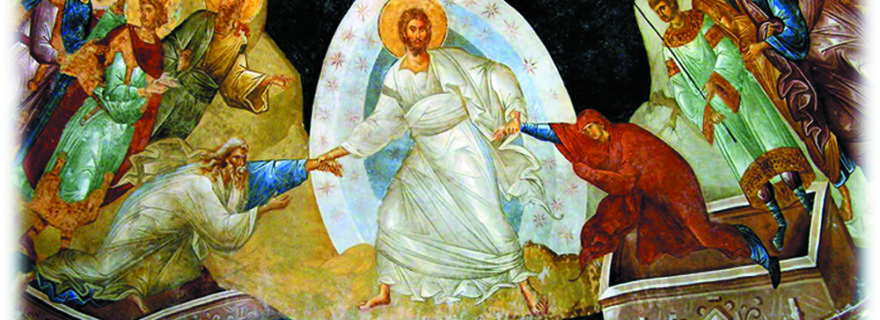
I am the Light of the world.
The most important of the Holy Services celebrated in the Holy City of Jerusalem, both for its importance and its antiquity, is the Holy Light ceremony during Holy Week. On Holy Saturday, in the Church of the Resurrection, the place where the burial and resurrection of the Lord Jesus Christ took place, one of the greatest miracles of Orthodoxy takes place. Today, after two thousand years, the same Light still appears, inside and around the Tomb of Christ.
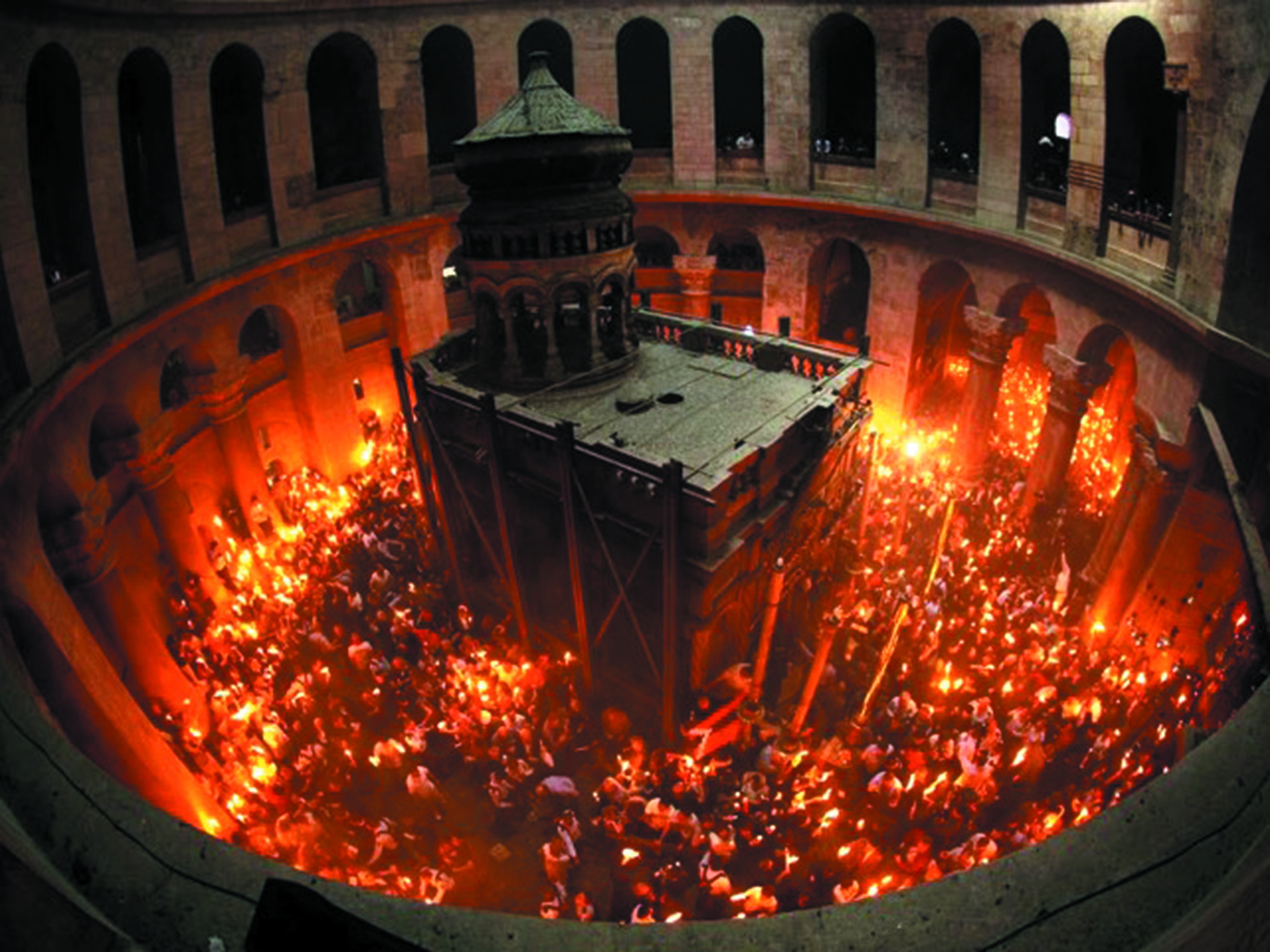
For many people, the appearance of the Holy Light is a true miracle, and there are those who doubt it. What cannot be disputed is that this is a historically documented event, with dozens of testimonies.
All the testimonies speak of a Light coming down from heaven, lighting the candelabra on the Tomb of Christ, while at the same time blue-white glows spread through the Church of the Resurrection, lighting other candelabras and candles of the faithful.
The descriptions of the Holy Light by dozens of chronographers, French, German, English, Italian and Armenian, confirm each other. Many of these accounts are so detailed and detailed that they take us mentally to the place where the miracle took place. The historical testimonies of distinguished Arabs and Persians are also of great interest, and it is surprising that the Muslims of Jerusalem, although irreligious, participated by the thousands in the ceremony of the Holy Light, accepted the authenticity of the miracle and carried the Holy Light to their mosques.
Many are those who wonder why only the Orthodox Patriarch enters the Holy Sepulchre during the Holy Light ceremony.
In 1187, when the Sultan of Egypt and Syria, Saladin, conquered Jerusalem after 88 years of occupation by the Franks, the shrines of the Holy Land were again attributed to the Orthodox. The Saladin Decree states that:
“the patriarch of the Romans will be the master of the Kamare (temple of the Holy Sepulchre) and he will take from the tomb of Ica [Jesus] the Holy Light to transmit it to the Christians”.
Saladin’s decree protected the Holy Sepulchre for centuries to come. No Muslim has ever dared to violate his decision.
Before the Holy Light service, a thorough check is carried out by the Israeli police, as well as by representatives of other Christian denominations that have rights to the Church of the Resurrection, such as Armenians and Copts, to make sure that there is absolutely nothing inside. The entrance is sealed with pure wax by all the representatives of the denominations and they place their official seal on the wax.
The Patriarch of Jerusalem, before entering the Cubicle, takes off his high priestly robe and remains only with the white stole, holds the 33 candles and enters the Holy Cubicle, where everything is extinguished and there he reads the blessing, waiting for the coming of the Holy Light. At almost the same moment that the Light appears inside the Tomb, it is diffused into the Temple in the form of blue-white flashes. The ceremony ends with the exit.
TALES
Archbishop Arethas of Caesarea
The Arch. Arethas, born in Patras in 850 AD, was a prominent personality, author of important works and contributed to the preservation of Greek literature. In a letter to the Emir of Damascus on behalf of the Emperor Romanus I, he states the following about the Holy Light:
“But to this day, His Holy and Sacred Tomb is miraculated every year on the day of the Resurrection. And while the Emir of Jerusalem is present near the Tomb, with the entrance sealed by him, and while the Christians are in the temple of the Resurrection and exclaiming Lord Mercy, suddenly there appears a flash of lightning and the candelabrum is lit with Light.”
The Arab jurist Ibn al-Qas [940 μ.χ.]
Ibn al-Qas, an expert in Islamic law, and the author of several theological works, recorded in detail the ceremony of the Holy Light.
“On the Christian Easter, the Holy Saturday, the faithful leave the place of the tomb and pray […] The emir and the imam of the mosque are present. The Sultan locks the door of the Tomb. They all remain motionless until they see a light similar to a white fire coming from inside the Tomb […] the flame of the lighted candle does not burn […] Then they draw up and deliver to the Sultan a report confirming that the fire has come at this hour and day…”
The acceptance of the miracle by the Muslim community of Jerusalem is made even more obvious by the reference to the Imam lighting the candles with the Holy Light in the mosque, i.e. the ‘Dome of the Rock’ which is considered the third holiest site in the Islamic world after Mecca and Medina. All this takes place in the first half of the 10th century, when, despite the fierce conflict between Christianity and Muslimism, the Resurrection of the Lord was celebrated with every solemnity by the political and religious rulers of the city.
The letter of the cleric Nikitas to the Emperor Constantine Porphyrogenitus
At Easter 947 AD, the Greek cleric Nikitas arrived in Jerusalem as a representative of Emperor Constantine VII Porphyrogenitus in order to deliver a financial grant to Patriarch Christodoulos. Immediately after the ceremony of the Holy Light, he writes a letter to the Emperor in which he describes the events he experienced. [According to the manuscript: on April 7, 947 A.D., on the morning of Holy Saturday, an emir arrived from Baghdad, who informed the Patriarch of his decision to abolish the Holy Light ceremony because of the great influence it had on the Muslim population. He accused the Patriarch that the miracle was being magically performed and that it was because of this miracle that the Christian faith had spread throughout Syria. Then the Patriarch replied. […] If you had seen this phenomenon only once or twice, and had not been assured of it countless times by the facts themselves, we would have endured your words. But during the period when you ordered that an iron instead of a fuse should be placed in the candelabra, and then by Divine consent we all saw it light up like a candle, until when will you attempt to torment us because of this superlative fact?
The Persian philosopher al-Biruni [1000μ .χ.]
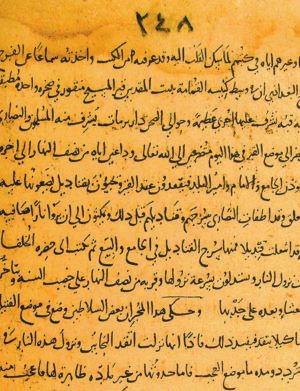
Al-Biruni’s report on the ceremony of the Holy Light. Codex Beyajit 4667, f.348, 17th century. Istanbul, Beyazit Library.
Al-Biruni [973-1048], was one of the greatest scientists of all time, an astronomer, philosopher, mathematician, physicist, cartographer and polymath. He was the first person to conduct research on the Light. From the outset, he makes it clear that he would not have spoken on this issue if there had not been unanimity among the opponents of the miracle who had experienced the event as eyewitnesses.
In his work – The Chronology of the Ancient Nations – in the chapter dealing with the feast of the Christians he writes the following: the Christians and whoever else comes on that day to the place of the Tomb, invoking the Most High God, the muezzin of the mosque, the chief imam of prayer and the emir of the city still come and sit beside the Tomb. The Christians meanwhile have already extinguished their lamps and torches and wait until they see a clean fire which lights a candelabra. From this fire they light the candles inside the churches and mosques. In another place it says…a sultan put a copper wire in place of the fuse, so that the Light would not be lit, …
“But when the fire burned down,
the brass is lit”
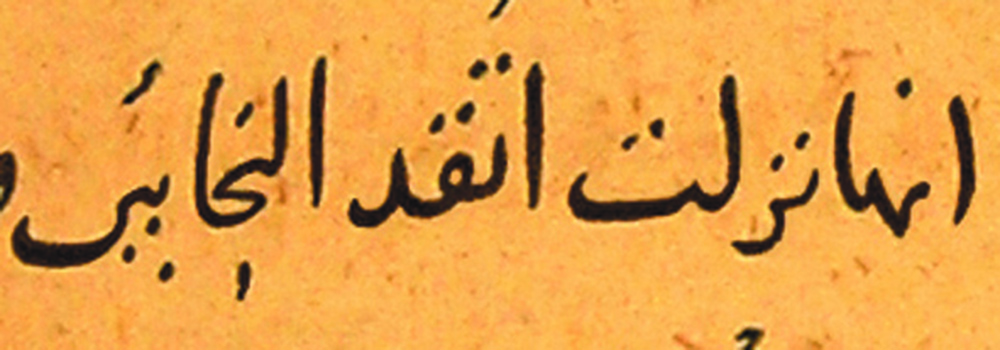
From the manuscript Beyajit 4667
The destruction of the Church of the Resurrection in 1009
The Church of the Resurrection in 1801
In 1009, the Caliph of Egypt al-Hakim ordered the burning and razing to the ground of the Temple of the Resurrection, as well as other monasteries.
The Syrian historian and poet, Ibn-al-Qalanisi, in his work, The History of Damascus, explains the reason for the destruction. The effect of the miracle of the Holy Light on the Muslims had gone out of control. Muslims by the thousands visited the Holy Sepulchre with Christians at Easter, this angered the caliph, and such was his destructive fury that, as al-Qalanisi mentions, <no stone left upon stone>. The miracle of the descent of the Light was the decisive reason for the destruction of the Temple. Byzantinologist Stephen Runciman argues the same.
The Persian physician al-Masihi [c. 990 AD]
Al-Masihi, one of the most prominent physicians of the 10th century, teacher of the great philosopher and physician Avicenna, wrote several medical writings, the most important of all being a Medical Encyclopedia, “The 100 Chapters of Medicine”. In his writings, a narrative about the Holy Light is preserved.
The history of this fire is that on the night God raised Jesus, the night of the 15th of the [Hebrew] month of Nisan, and every year since then, a fire comes down from the ether in such a way that it becomes visible to the people, and lights the candelabra in the Temple of the Resurrection.
The Persian doctor wanted to make known to his compatriots through this miracle the truth of the Resurrection of Christ, because he himself believed and became a Christian.
But this choice cost him his life.
Around the year 1012 Turkish Sultan Mahmud of Ghazna ordered al-Masihi to be imprisoned, along with two other important scholars of the Islamic world at the time, al-Biruni and Avicenna.
The miracle of the crack in the column
When Sophronius IV was Patriarch of Jerusalem in 1580, the following paradoxical miracle took place on Holy Saturday. The Holy Light came out of the gate of the Church of the Resurrection by tearing the column, which can be seen even now. The reason was the following: The Armenians, at that time, gave money to the ruler of Jerusalem to prevent the Patriarch and the Orthodox from entering the Church of the Resurrection, and so it was done. Only the Armenians entered, hoping to get the Holy Light. The Patriarch and the other Orthodox were standing outside the church praying. And then the pillar was torn and the Holy Light sprang out of it and lit the Patriarch’s candles. Because of this miracle, one of the Mohammedan doorkeepers of the temple loudly confessed Christ as the true Son of God and believed in Him. When the other Mohammedans heard him, they killed him immediately.
The Monk Mitrofanis
The monk Mitrofanis. from Kerasounda of Pontus, guardian of the Holy Sepulchre, the M. Saturday, 1926, driven by disbelief, he hid inside the Holy Cube at the time of the ceremony. “At that very moment, – as he recounts – when my agony was in terrible excess in the vast dead silence, when I had just heard my breath, I heard a slight wheeze. It was like a fine breeze of wind. And immediately – an unforgettable sight – I saw a blue light fill the whole Holy Place of the Tomb of Life. That blue light I saw in the aftermath of the event, swirling like a strong whirlwind… And immediately it began to change into an all-white light, as the Evangelist describes the Transfiguration of Christ the Savior. Then that all-white light was transformed into an all-bright disc for the sun and settled still just above the Patriarch’s head. Then I saw the Holy Elder Patriarch taking the bundles of thirty-three candles in his hands. It lifted them up and gave the image of waiting. He expected from God the coming of the eternal light. And as he slowly raised his hands, immediately in the twinkling of an eye, as if he were touching a burning furnace, the Holy Candle and the bundles of
candles. Suddenly, without even realizing it, that bright disc disappeared from my eyes”.
This testimony was narrated by Fr. Mitrofanis, after 55 years at Easter 1980 to the Cypriot priest Savvas Achilleos.
We borrowed the testimonies about the Holy Light from the book by Harry K. Scarlakidis. It is a book of scientific research with 70 historical accounts of the Holy Light, little known. The author, having access to the treasures of the great libraries and authentic sources, studied for years unknown and untranslated manuscripts. Of particular value are the photographs of the manuscripts in the book, which document the validity of the research.