







Christmas! The celebration of love, of God’s extreme condescension towards people!
The birth of Christ is spoken of in the Bible, in the Fathers of the Church, and in its wonderful Hymns. They analyse the “Great Mystery” in a miraculous way and address the heart of man and make man, who approaches it with humility, become a sharer of the whole event. “A child is born… and his name is called the Angel of the Great Council, the Angel of the Great Parliament, the Wonderful Counselor, the Mighty God, the Exalted in Power, the Prince of Peace, the Father of the age to come” (Prophet Isaiah). A return to the lost paradisiacal state of peace, justice, love, was what humanity expected. That is why the sacred and mythological traditions of all ancient peoples spoke of the coming Savior.

The Prophets foretold it, but so did men and women of the Gentile world, as the surviving testimonies attest. God, as the Father of all Mankind, guided the Nations in anticipation of the coming of the Redeemer by comforting man. The expectation of the expected Messiah was the central axis of the entire ancient period. Jews, Greeks, Chinese, Egyptians, Egyptians, Persians, Indians and Romans were all waiting for the coming of God the Redeemer in human form. The Chinese, writes St. Nectarios, believed that a saint would be sent from heaven who would rule the earth and the sky. The wise Confucius (551-579 BC) prophesied to his followers: “I Confucius have heard it said that a holy man will arise from the West who will do wondrous works. He will be sent from heaven and will rule the whole Earth.” The Persians also expected a great Prophet whom they called the Word of God and the Mediator between God and men.

Before the birth of Christ, the seer Barlaam – in the time of Moses – prophesies in a divine vision that “a man is about to be born of the race of the Jews, who will rule the world. Those who sing his praises will be praised, A s t r o will a n d a t t h e r will be born a man who will crush the kings who do not worship him “2. Ever since then the Persian seers had been waiting for that bright star, the sign of the birth of the expected king. After 1300 years the bright star appears according to prophecy in the sky and the three wise men follow it to the cave of Bethlehem. But in the ancient Greek world, too, the godlike expectation is manifested with intense intensity. To the Greeks the sought-after Redeemer would come as a God-man saviour, because this is the way God can be known by man: that is, by His actual incarnation and His self-revelation.

In the Myth of Pandora, the person of Eve is referred to. Curiosity and desire lead Pandora to open the box given to her by the gods as a wedding gift – despite their warning never to open it – but disobedience leads her to open the box and thus, according to the myth, all the evils in the human race begin. The only thing left in the box, at the bottom, was hope. The human race was strengthened in the hope of its salvation by waiting for the Redeemer.

Plato’s Politia3 contains a prophecy almost equal to those of the Old Testament prophets. Plato prophetically speaking like the Prophet Isaiah says : “The righteous will be stripped of everything except justice, without wronging anyone he will be discredited as unjust he will be tortured for his justice……… he will remain unmoved until death and while he is righteous you will be considered unjust… he will be scourged, twisted, bound, and finally nailed to a stake”.

In Aeschylus’ play Prometheus the Bound, Prometheus, being pinned in the Caucasus on the rock of martyrdom, predicts that his redeemer will be born of the virgin Io and God (v.772, 834, 848), that is, he will be the son of God and the son of the Virgin. This God-Man will overthrow the authority of the old gods and destroy them and their power (908,920). Hermes, then sent by Jupiter, foretells to Prometheus the following: “do not wait to be delivered from your pains before God takes your passions upon himself and descends of his own accord to Hades the unsullied, to the untamed depths of Tartarus” (v. 1041-1043). Socrates in his apology states the following: “You will remain asleep all your life unless God spares you and sends you someone else” (Plato, Apology of Socrates 18{31a}).
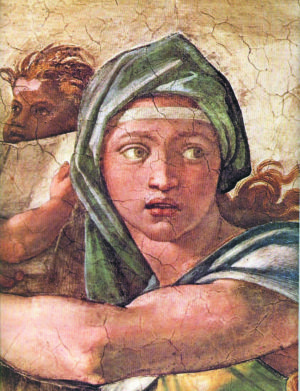
Prophecies of Sibylla – the priestess of Apollo – in a manuscript preserved on Mount Athos in the Monastery of Docheiarion, entitled “Memorandum to the Holy Apostle Philip”, the following is mentioned about the coming of Christ: “After a long time someone will arrive in this multitudinous land and will be born with flesh without blemish. With inexhaustible limits as Deity he will redeem man from the corruption of incurable passions. And he shall be envied by unbelieving people and hanged on high as a prisoner to death. All these things shall he suffer in meekness.” From various sources it has been cross-checked how these and other prophecies – either of Sibyl or of other wise Greeks – were used by Saint Catherine. In 305 A.D. the Emperor Maximino persecuted the Saint as a Christian and gathered the wisest men of the time to persuade her. The Saint, all-wise and educated in Greek learning, in her effort to prove that Christ is the only God, quoted – among other things – the prophecies of Sibylla which are preserved in the Athonite Monastery of Dionysius and which state: “I prophesy to you a threefold God on high whose eternal Word in an unsuspecting daughter will be conceived, just as the fire-bearing bow, piercing the midst of the world. All the world having been brought back to life, and to the Father he will offer it as a gift. Mary shall be her name.” Of the coming of Christ the Saviour, Clement of Alexandria (2nd century AD), in his work Stromaeus (5,13), states unequivocally: “I am not among Greeks clearly proclaiming our Saviour”, i.e. “It is not possible, I think, for our Saviour to be proclaimed more clearly by the Greeks”.


The Jewish people have lived for centuries with this lifelong expectation. The Old Testament specified the place, manner, and time of the Messiah’s birth. The inspired Jacob proclaimed that “All the nations will wait for him “4 and the prophet Isaiah prophesied 800 years before the birth of Christ: “And you, Bethlehem, land of Judah, are by no means small among the rulers of Judah. For out of thee shall come forth a prince to rule my people Israel” and “Behold the virgin in her flesh, and she shall conceive a son, and thou shalt call his name Emmanuel. “5 The Roman historian Tacitus testifies that all peoples in his day had their eyes fixed on Judea, hoping that from there the expected king would come.
Virgil, a Roman poet, interpreted an oracle of Sibyls announcing the coming of the King whom those who would acknowledge him would be burned. In his Life of Augustus, the Roman historian Suetonius reports that a miracle had occurred in public in Rome in which it was announced that nature was pregnant with a great person who would become King of the Romans. And that the Senate, being afraid, passed a statute forbidding at that time the bringing up of any male child. This statute remained unenforced in Rome. It was only enforced by Herod, who put to death all male children, even his own, for fear of being dethroned by the expected King. (Saint Nectarios Christology, p.27).΄ And Augustus Caesar, when he went to Delphi and asked the Oracle who was to reign after him, received in reply the following oracle: “A Hebrew child shall reign after thee. After you leave here, you will visit Hades.” On this August our Lord Jesus Christ was born, and the Church sings: “By Augustus, the multitude of men is abolished, and by the incarnation of the Holy One, the polytheism of the Gentiles is abolished.” In the memory of all mankind, after the disobedience of the firstfruits, the Word of God was given as a promise full of comfort and hope for the coming of the Redeemer: “And I will be angry with thee and with the woman ……He shall bruise thy head, and thou shalt bruise his heel “6, i.e., “He shall bruise thy head (by his resurrection), while thou shalt crucify him.” .
– This is the First Gospel, the first good news of the salvation of mankind. With this the firstfruits were strengthened and this is the legacy they left to their descendants.
MERRY CHRISTMAS